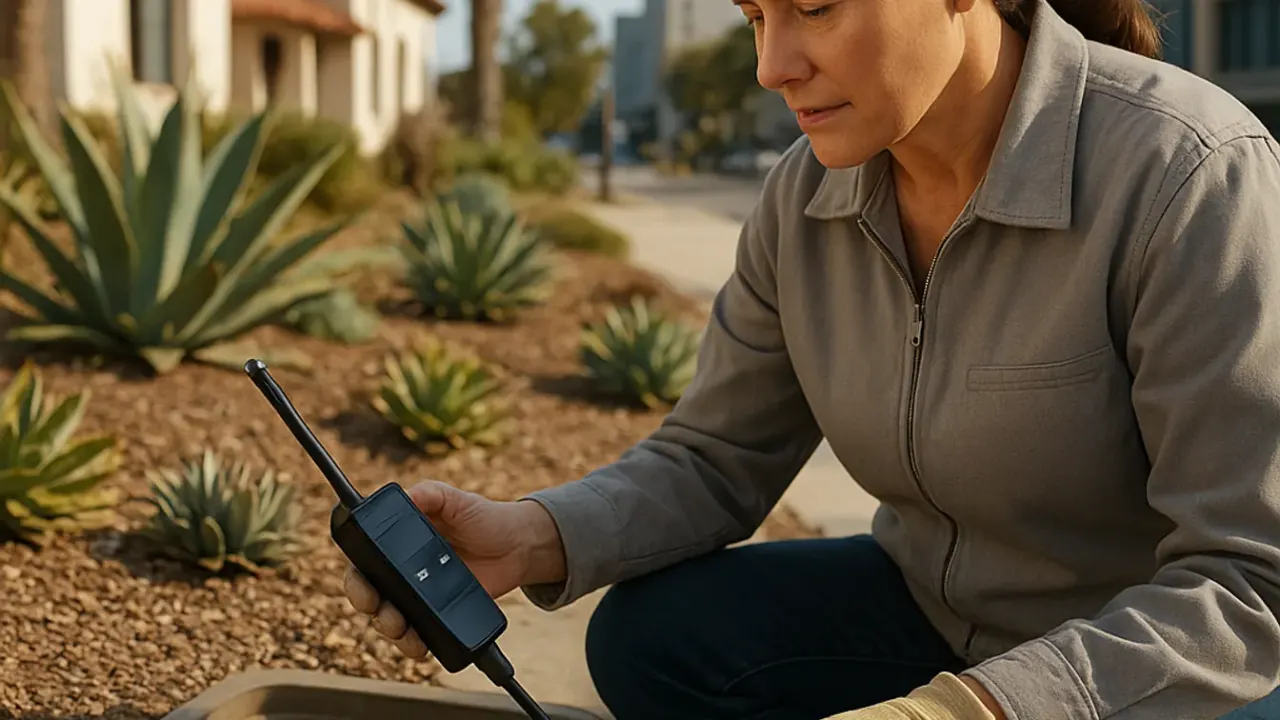
You can use your water meter to find a leak by shutting off every fixture in the house, noting the meter reading, waiting 30 to 60 minutes, and checking whether the reading changed. If the meter moved while nothing was running, you have a leak somewhere on the pressurized side of your plumbing. This guide walks you through the exact test we run on service calls across Santa Ana, how to read the results, and the point where DIY leak detection stops being worth your Saturday.
What your water meter can and cannot tell you
Your water meter is a flow counter. It measures water passing from the city main into your property, and that is all it does. It will tell you that water is moving when it should not be. It will not tell you where the water is going.
That distinction matters because it saves you from tearing into the wrong wall. A meter that creeps overnight could be a toilet flapper, a pinhole leak in a copper line behind the kitchen cabinet, a cracked irrigation lateral under the lawn, or a slab leak under the hallway floor. Same meter signal, four completely different repairs.
What the meter does give you is a yes-or-no answer on the most expensive question: is my plumbing actively losing water right now? Everything after that is narrowing down location.
If you want a second opinion on the meter test itself, our professional leak detection Santa Ana CA team runs the same isolation steps on every call, then uses acoustic and thermal tools to pinpoint the source.
How do I use my water meter to check for a leak in Santa Ana CA?
The test takes about an hour of waiting and five minutes of actual work. Here is the sequence, in order.
Step 1: Find your meter and clear the lid
Most single-family homes in Santa Ana have the meter in a concrete or plastic box near the sidewalk, usually within a few feet of the property line. Some older homes in leak detection in Floral Park have meters tucked behind low hedges or under decorative covers that have not been lifted in years. Clear the dirt and check for standing water in the box itself. Water in the meter box is its own clue.
Step 2: Shut everything off
Turn off every fixture that uses water:
- All faucets, inside and out
- Dishwasher, washing machine, ice maker
- Irrigation controller (set it to OFF, not just a rain delay)
- Pool auto-fill valve and spa makeup line
- Water softener regeneration cycle
- Evaporative cooler if you still run one
Then check the toilets. Lift the tank lid and confirm the flapper is seated and the fill valve is not hissing. A running toilet is the single most common cause of a meter that will not sit still, and it is also the cheapest to fix.
Step 3: Take a baseline reading
Write down every digit on the meter face, including the decimals. On most Santa Ana meters you will see a six-digit odometer plus a small dial or triangle. The triangle is your leak indicator. On a quiet system it should be completely still.
Step 4: Wait 30 to 60 minutes with nothing running
Do not flush a toilet, do not run the sink, do not water the lawn. Thirty minutes is the minimum. An hour is better because slow leaks show up more clearly over time.
Step 5: Read the meter again
Compare the second reading to the first. If the numbers match and the triangle never moved, your pressurized system is holding. If the numbers advanced, water moved through the meter while nothing in the house was calling for it.
That is the whole test. It is the same water leak detection Santa Ana CA baseline we start with before we bring in any equipment, and it costs you nothing but an hour.
Reading the results: what a spinning meter actually means
A water meter spinning with no water running in Santa Ana means water is leaving the pressurized side of your plumbing somewhere between the city main and your fixtures. The size of the movement tells you roughly how big the leak is.
Here is how we translate meter movement into real numbers. A standard residential meter in Santa Ana measures in cubic feet, and one cubic foot equals about 7.48 gallons.
- Triangle barely creeping, no odometer change in an hour: usually under a gallon per hour. Often a toilet flapper, a slow irrigation valve weep, or a pinhole starting to open.
- One full cubic foot in an hour: roughly 7.5 gallons per hour, or about 180 gallons a day. That is a real leak and it will show on your bill.
- Several cubic feet in an hour: 30 gallons per hour or more. This is a burst or near-burst. Shut off the main and call someone today.
For context, Santa Ana water rates in 2026 run in tiers, and the upper tiers cost several times the base rate. A leak of 180 gallons a day is roughly 5,400 gallons a month, which is enough to push a normal household into the highest tier and add real money to the bill.
One more thing the meter tells you: whether the leak is before or after your shutoff valve. Close the main valve at the house and watch the meter. If it keeps moving, the leak is between the meter and the house, which points to a water main leak detection Santa Ana CA issue on the service line. If it stops, the leak is inside the house.
Common mistakes that ruin a DIY water meter leak test
We get called out to a lot of homes where the homeowner already ran the meter test and got a false result. Nine times out of ten it is one of these.
Leaving the irrigation controller on AUTO
An irrigation cycle that fires during your test window will move the meter and send you hunting for a leak that does not exist. Set the controller to OFF, not to a rain delay, and not to a seasonal adjust of zero. Off means off.
Missing a running toilet
A flapper that fails to seal can pass 200 gallons a day without making a sound. Lift the tank lid on every toilet in the house and look at the water level. If you can hear water trickling, the flapper is the leak.
Testing during a water softener regeneration
Most softeners regenerate on a timer, often in the middle of the night. If you run your test at 2 a.m., you may catch the regeneration cycle and misread it as a leak.
Not accounting for the pool
An auto-fill valve that is stuck open will feed the pool continuously and show up on the meter as a steady leak. Shut the fill line at the valve, not just at the float. If the pool level still drops with the fill off, you have a pool leak detection Santa Ana CA problem, not a house plumbing problem.
Reading the wrong dial
Some meters have a low-flow indicator that spins at a different rate than the main odometer. Read the odometer digits, not just the sweep hand, and write down the full number.
When to call a professional instead of DIY leak detection
Call a professional when the meter confirms a leak but you cannot see water anywhere obvious, when the meter movement is large enough to suggest a burst, or when the leak is under a slab, under the lawn, or inside a wall. Those are the three situations where DIY tools run out of road.
Here is the practical line. If the meter test says you have a leak and you have already ruled out toilets, irrigation, and the pool, the next step is locating it. That means acoustic listening equipment, thermal imaging, and sometimes a camera down the sewer line. You cannot buy that gear at a hardware store, and renting it for a weekend costs more than having us do the inspection.
There is also a risk question. A slab leak that goes unaddressed can undermine flooring, warp baseboards, and in bad cases compromise the foundation. A pinhole leak in a copper line inside a wall can soak drywall and insulation for weeks before you see a stain. The longer those run, the bigger the repair.
Our team handles this every week across Santa Ana, including older downtown properties where original galvanized and copper lines are now 60 to 80 years old. If you are in one of those homes, leak detection in Downtown Santa Ana often turns up more than one issue once we start looking.
We find the leak, fix it, and test the line before we leave. You get a flat price before we start, and we do not sell you a repipe if a repair will hold.
Frequently Asked Questions
How do I use my water meter to check for a leak in Santa Ana CA?
Shut off every fixture, irrigation zone, pool fill, and water softener, then write down the meter reading. Wait 30 to 60 minutes with nothing running and read it again. If the number moved, you have a leak on the pressurized side of your plumbing.
What does it mean if my water meter keeps spinning?
A meter that keeps spinning with everything off means water is actively leaving your system. One cubic foot per hour is about 7.5 gallons, or 180 gallons a day. Check toilets and irrigation first, then call for a professional locate if those are clean.
Can I do leak detection myself in California?
Yes, the meter test is legal and safe for any homeowner to run, and it is the best first step. What you cannot easily do yourself is pinpoint a leak under a slab, inside a wall, or underground. That requires acoustic and thermal equipment.
When should I call a professional leak detection service in Santa Ana?
Call when the meter confirms a leak but you cannot find visible water, when the meter moves more than one cubic foot per hour, or when you suspect a slab, wall, or underground line. Those cases need locating equipment to avoid unnecessary demolition.
How much water does a small leak waste?
A pinhole leak the size of a pencil tip can waste 5 to 10 gallons a day, and a failed toilet flapper can pass 200 gallons a day. Over a month, that is enough to move a Santa Ana household into a higher water tier.
Get help with leak detection in santa ana
If your meter test says you have a leak and you cannot find it, we will locate it, fix it, and confirm the repair with a second meter test before we leave. Call Planet Plumbing at 714-844-9877 and we will get a technician out to your Santa Ana home.