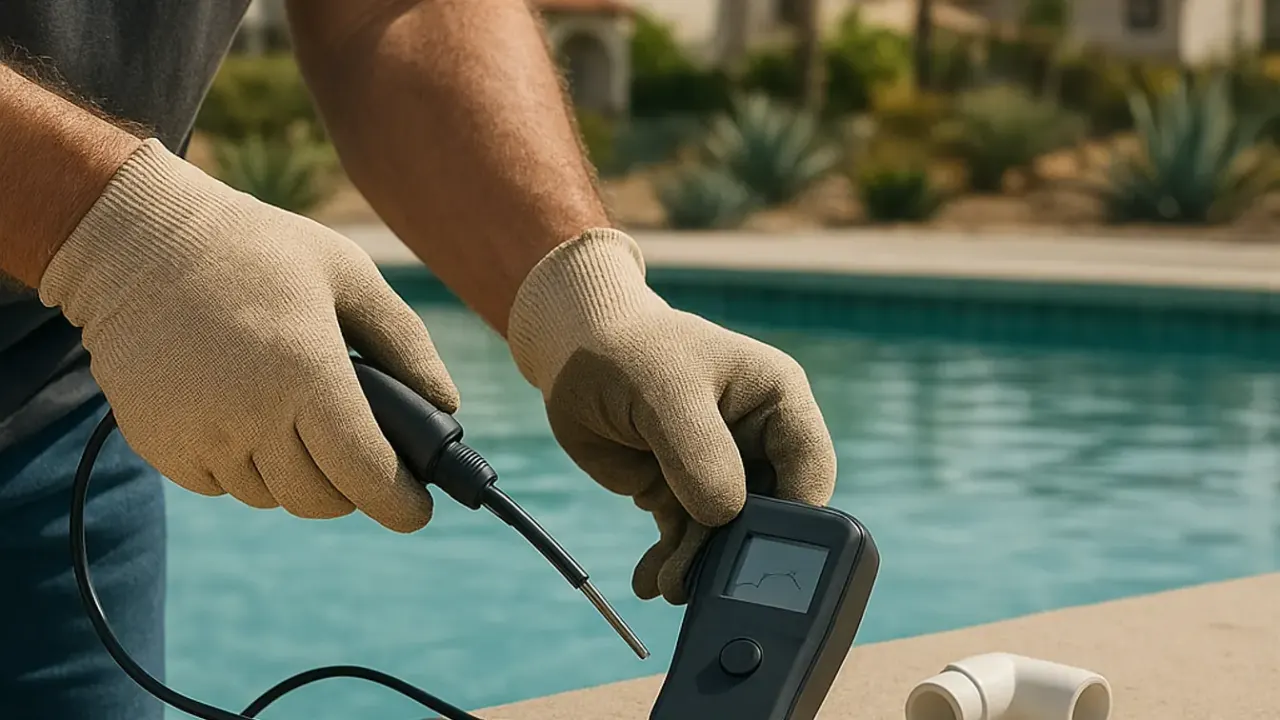
If your pool drops more than a quarter inch overnight with the pump off, you almost certainly have a leak, not evaporation. Evaporation in Santa Ana runs about 1/8 to 1/4 inch per day in summer and far less in winter, and it does not accelerate just because the sun went down. A pool that loses half an inch or more between 10 p.m. and 6 a.m. is telling you water is escaping through the shell, the plumbing, or the equipment pad.
We are Planet Plumbing, and pool leak work is a big part of what our technicians do across Santa Ana. This post explains why overnight loss points to a leak, how to run the bucket test yourself, where these leaks hide, and when it is time to bring in pool leak detection Santa Ana CA equipment.
Why does my pool lose water overnight?
Overnight water loss in a Santa Ana pool is caused by a leak whenever the drop exceeds normal evaporation, because evaporation slows after dark while a leak keeps running at the same rate. That is the whole answer. The sun drives evaporation; darkness removes it. So if the pool keeps dropping at 2 a.m., something is pushing water out of the system.
Three things cause that overnight drop:
- A shell leak - a crack in the plaster, a failed light niche gasket, or a torn skimmer throat that lets water seep into the soil.
- A plumbing leak - a cracked return line, a split in the suction line under the deck, or a broken fitting at the pump.
- An equipment leak - a bad shaft seal, a cracked pump housing, or a leaking multiport valve on the filter.
Each one behaves differently. A shell leak usually stops dropping once the water falls below the crack. A plumbing leak keeps going until the pool drains past the skimmer. An equipment leak shows up as a wet pad and a pool that loses water only while the pump runs.
If you have already ruled out evaporation and the level keeps falling, that is the point where most homeowners start searching for leak detection Santa Ana CA help rather than guessing.
How much water should a pool lose per day in California?
A pool in Santa Ana should lose about 1/8 to 1/4 inch per day to evaporation in summer, and 1/16 to 1/8 inch per day in winter. Anything beyond that, especially overnight, points to a leak. California's inland heat and low humidity push evaporation higher than coastal cities, but even in August a healthy pool rarely drops more than a quarter inch in 24 hours.
Here is the range we use when we evaluate a pool:
- Normal: 1/8 to 1/4 inch per day, mostly during daylight hours.
- Suspect: 1/2 inch per day, or any measurable drop overnight.
- Definite leak: 1 inch or more per day, or 2 inches in 24 hours with the pump off.
If your pool is losing 2 inches of water a day in Santa Ana, California, you are losing roughly 500 to 600 gallons daily on a typical 15-by-30 pool. That is a water bill problem and a soil problem at the same time. Saturated ground under a deck or near a foundation can shift soil and crack flatwork.
Pool leak or evaporation in Santa Ana? How to tell
Telling a pool leak from evaporation in Santa Ana comes down to timing, temperature, and where the water stops. Evaporation happens mostly in the afternoon, when air temp is highest and humidity is lowest. A leak does not care what time it is.
Three quick checks:
- Mark the level at night. Note the water line at 9 p.m. and again at 7 a.m. with the pump off. More than 1/4 inch lost overnight is a leak.
- Watch where it stops. If the pool drains to the bottom of the skimmer and holds, the leak is at the skimmer. If it holds just under the light, the light niche is the likely culprit.
- Look at the pad. A wet spot under the pump, filter, or heater means the equipment is leaking, not the shell.
Santa Ana sits in a basin where summer temps regularly hit the high 90s and humidity drops into the teens. That drives real evaporation, so a small daily drop is normal here. But evaporation does not double overnight. If your pool is losing water overnight in Santa Ana CA and the daytime loss matches the nighttime loss, you have a leak.
The bucket test: the 24-hour answer
The bucket test for a pool leak is the fastest way to separate evaporation from a real leak, and it takes about 24 hours. You do not need tools beyond a bucket, a marker, and a brick.
Here is how to do a bucket test in Santa Ana CA:
- Fill a 5-gallon bucket with pool water to about 2 inches from the rim.
- Set the bucket on the first or second step of the pool so it sits in the water but does not tip.
- Mark the water level inside the bucket and the pool water level on the outside of the bucket with a marker or tape.
- Run the pump normally for 24 hours. Do not add water.
- Compare the two marks. If the pool dropped more than the bucket, you have a leak.
If both dropped the same amount, that is evaporation. If the pool dropped 1/2 inch and the bucket dropped 1/8 inch, you have a 3/8-inch leak per day. That is enough to justify a professional look.
Run the test twice if you want a clean read - once with the pump on and once with it off. A leak that only shows up with the pump running is almost always in the pressure side plumbing. A leak that shows up with the pump off is usually in the shell or the suction side.
Where Santa Ana pools actually leak
Santa Ana pools leak in predictable places, and after enough jobs you learn to check them in order. The most common spots we find are the skimmer throat, the light niche, the return fittings, and the underground plumbing between the pool and the equipment pad.
Here is what we see most often:
- Skimmer throat cracks - the plastic skimmer body separates from the concrete, and water slips behind it.
- Light niche gaskets - the seal around the light housing dries out and fails, especially on pools over 15 years old.
- Return line fittings - the threaded fittings at the pool wall crack from ground movement.
- Underground plumbing - the PVC between the pool and the pad cracks from soil shift, root intrusion, or age.
- Equipment seals - the pump shaft seal, the filter O-ring, and the multiport valve gasket.
Older neighborhoods around Floral Park have pools from the 1950s and 1960s with original copper and galvanized plumbing, and those lines fail differently than modern PVC. In Downtown Santa Ana, we see more rooftop and courtyard pools where the equipment sits far from the water, which makes underground line leaks harder to spot without acoustic gear.
When the leak is under the deck or in the line to the pad, we use acoustic leak detection Santa Ana CA to listen for the escaping water and pinpoint the break before anyone cuts concrete. That saves a homeowner hundreds in unnecessary demolition.
What to watch out for: common mistakes
The biggest mistake Santa Ana homeowners make with a leaking pool is adding water and waiting. Every week you top off a leaking pool, the water is going somewhere - into the soil under your deck, your planter beds, or your foundation. That is how a $600 repair turns into a $6,000 slab or deck job.
Other mistakes we see:
- Blaming evaporation in winter. Evaporation drops to almost nothing in December and January. If the pool still drops 1/2 inch a day, it is leaking.
- Assuming the pump is the problem. A pool pump running but losing water in Santa Ana CA is usually a sign of a pressure-side plumbing leak, not a bad pump.
- Dye-testing the whole pool. Food coloring only works on visible cracks and fittings. It will not find a leak 18 inches under the deck.
- Letting the water drop too far. If the pool drains below the skimmer, the pump can run dry and burn up. Shut the pump off if the level falls below the skimmer mouth.
- Hiring a leak company that only does dye tests. If they cannot pressure-test the lines or use acoustic or thermal gear, they are guessing.
One more: do not assume your homeowner's insurance covers a pool leak. Most California policies treat gradual leaks as maintenance, not a covered event. Fixing it early is cheaper than fighting the claim.
When to call a professional
Call a professional when the bucket test shows the pool dropping faster than the bucket, when you see 2 inches of loss in 24 hours, or when the water stops at a specific level and holds. Those three signals mean the leak is real and locatable.
We also get calls when the ground around the pool is soggy, when the pump loses prime every day, or when the water bill jumps by more than 2,000 gallons in a month with no other explanation. All of those point to water leaving the system somewhere you cannot see.
Our team handles leak detection and repair Santa Ana CA in one visit whenever possible. We pressure-test the plumbing, scan the shell, check the equipment pad, and mark the leak before we quote the fix. Typical 2026 pricing in this area runs $350 to $650 for detection on a standard residential pool, and most repairs fall between $500 and $2,500 depending on whether we are replacing a fitting, a section of line, or a light niche.
If the pool shares plumbing with a spa, we test both at the same time. Same for pools tied into an irrigation loop - we have found more than a few "pool leaks" that turned out to be a broken sprinkler valve feeding the same water meter.
Frequently Asked Questions
How much water should my pool lose overnight in Santa Ana CA?
A healthy pool should lose no more than 1/8 inch overnight, and often less. If you are seeing 1/4 inch or more between sunset and sunrise with the pump off, treat it as a leak and run a bucket test the next day.
How do I do a bucket test for a pool leak?
Fill a bucket with pool water, set it on the pool step, and mark both the bucket water level and the pool water level. Wait 24 hours with the pump running. If the pool dropped more than the bucket, you have a leak.
When should I call pool leak detection in Santa Ana?
Call when the pool loses more than 1/4 inch per day, when the bucket test shows a difference, or when the water level stops at a fixed point like the skimmer or light. Those are the three clearest signals.
Does pool evaporation count as a leak in California?
No. Evaporation is normal water loss and is not a leak. California water districts treat evaporation as expected pool operation, but a leak that sends water into the soil is a repair issue, not a maintenance item.
Can a pool leak fix itself?
No. Pool leaks only get worse. Mineral deposits, soil movement, and pump cycles widen the opening over time. A small skimmer crack that costs $300 to seal today can become a $3,000 deck repair in a year.
Get help with leak detection in Santa Ana
If your pool is dropping overnight and the bucket test says leak, we can find it and fix it. Planet Plumbing serves Santa Ana and the surrounding Orange County area with pressure testing, acoustic locating, and full repair in one visit.
Call us at 714-844-9877 and we will schedule a pool leak inspection at your home.